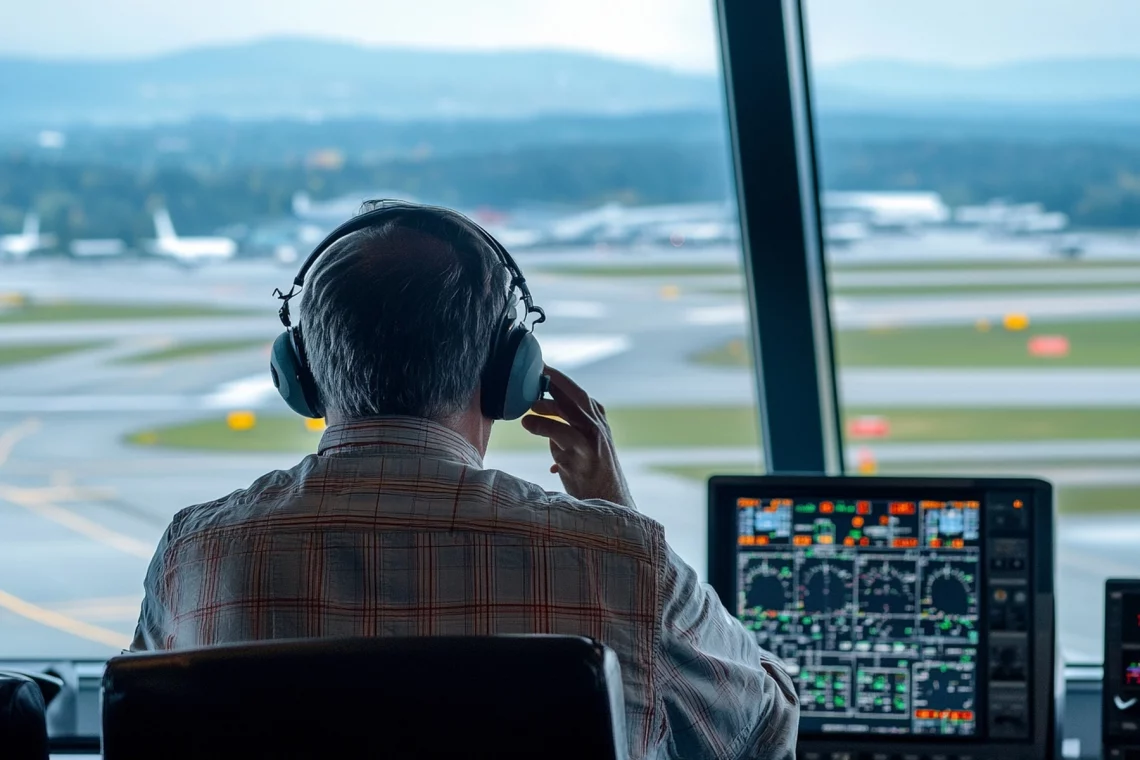
For years, the profession of air traffic controller has been considered one of the most fascinating and responsible jobs in the world. Every day, thousands of passenger and cargo aircraft move through Polish and European airspace, while the safety of hundreds of thousands of travellers depends directly on a small group of highly specialised professionals. The operational responsibility is enormous. In return, the aviation industry offers prestige, exceptional job stability and above-average financial benefits.
If you are wondering how to become an air traffic controller, what the daily work involves and what salaries look like in practice, this comprehensive guide will explain every stage of this unique career path.
Step 1: Formal Requirements and Key Psychophysical Qualities
The Polish Air Navigation Services Agency (PAŻP) maintains relatively accessible formal education requirements, focusing primarily on assessing candidates’ natural abilities and cognitive skills. The formal criteria include:
- At least secondary education: Although a university degree can be an additional advantage, a secondary school leaving certificate is formally sufficient.
- Excellent language skills: Candidates must have impeccable Polish language skills and fluent English at a minimum B2 level according to ICAO and CEFR standards.
- Clean criminal record and completed formal obligations: Candidates must have no criminal record and a regulated military service status.
- Medical fitness: The ability to obtain a Class 3 aviation medical certificate.
It is important to remember that the specific nature of an air traffic controller’s work requires unique mental abilities. Excellent three-dimensional spatial awareness, the ability to make accurate decisions quickly under time pressure, divided attention and resistance to prolonged stress are all essential qualities.
Step 2: Recruitment at PAŻP – FEAST Tests and Medical Examinations
The candidate selection process is exceptionally demanding. Statistics show that only 2–3% of applicants successfully complete the recruitment process. If your goal is a high salary, prestige and attractive earnings as an air traffic controller, you must successfully pass a multi-stage assessment procedure.
- Formal verification and preliminary tests: Assessment of submitted applications, language tests and basic logical reasoning exercises.
- FEAST test battery (First European Air Traffic Controller Selection Test): An international standard developed by EUROCONTROL. The FEAST I section assesses visual memory, logical thinking, spatial orientation and the ability to process multiple stimuli simultaneously. FEAST II, including modules such as DART, simulates dynamic radar traffic management under increasing task pressure.
- Job interviews and Assessment Center: Group tasks and interviews with psychologists assess interpersonal communication, the ability to deal with criticism and suitability for teamwork.
- Medical examinations conducted by a medical board: Detailed ophthalmological, audiometric, cardiological and neurological tests confirm the candidate’s readiness to perform operational duties.
Understanding the nature of these tests is essential for anyone planning to become an air traffic controller and hoping to avoid disqualification during the early stages of recruitment.
Step 3: Two-Year Training – From Theoretical Foundations to an ATCO Licence
Successfully completing the recruitment process opens the doors to the PAŻP Aviation Training Centre. The training lasts approximately 20–24 months and is divided into clearly defined educational stages.
1. Basic Training
Candidates acquire theoretical knowledge covering aviation law, meteorology, navigation principles, aircraft performance and standard aviation phraseology in English.
2. Rating Training
Training moves to advanced simulators that recreate real operational workstations. Trainees specialise in one of three areas: aerodrome control (TWR), approach control (APP) or area control (ACC).
This stage ends with a state examination conducted by the Aviation Examination Board and the acquisition of a Student Air Traffic Controller licence (Student ATCO).
3. On-the-Job Training (OJT)
The trainee works at a real radar workstation or in a control tower. Under the constant supervision of an experienced instructor (OJT-I), they manage actual aircraft traffic.
After completing the required number of training hours and passing the practical examination, the trainee receives a full ATCO licence. At this point, their salary increases significantly and approaches the target level.
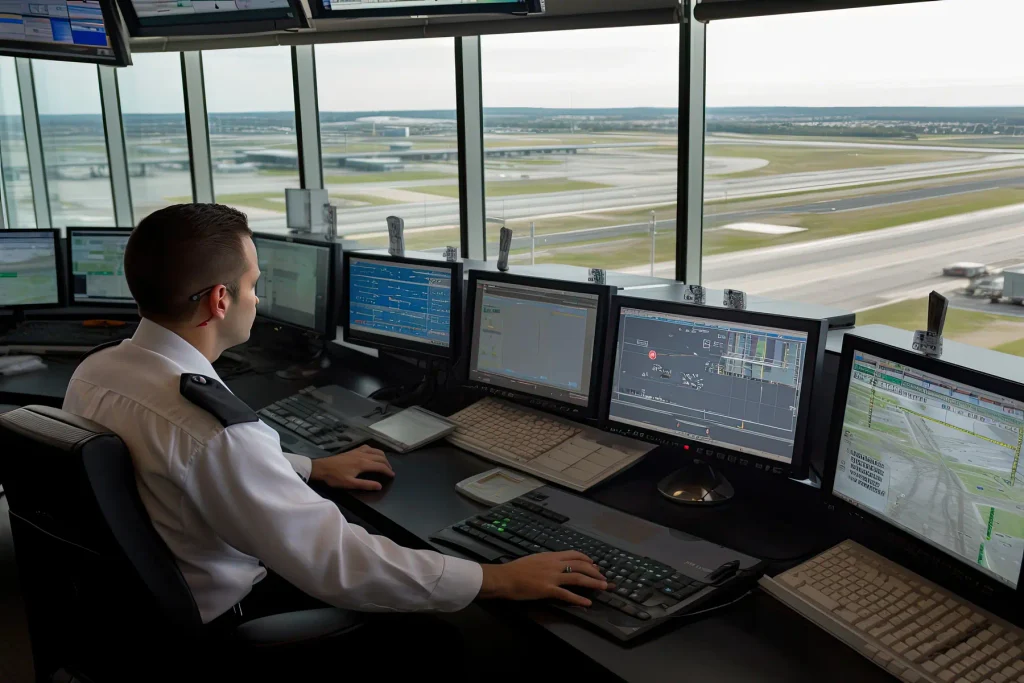
Step 4: The Daily Work of an Air Traffic Controller – Shift Organisation and Responsibilities
What does the daily work of an air traffic controller look like in practice? Air traffic control services operate continuously, 24 hours a day, 365 days a year. Shifts usually last between 7.5 and 8 hours. However, the amount of uninterrupted time spent working directly at a radar workstation is subject to strict safety regulations.
A controller cannot manage air traffic continuously for more than 2 hours. After this period, they are entitled to a mandatory break lasting at least 45–60 minutes, allowing them to recover in designated rest areas.
Daily responsibilities include maintaining safe vertical and horizontal separation between aircraft, issuing precise instructions for descents, climbs and course changes, coordinating with neighbouring sectors, and responding quickly to equipment failures, turbulence and sudden weather changes.
Every decision must be accurate. This is why candidates considering a career as an air traffic controller are selected according to such strict criteria.
Step 5: Finances and Career Development – Salaries at Different Stages
One of the most common reasons people are interested in this profession is the high earning potential. It is important to understand that an air traffic controller’s salary increases in line with their qualifications and years of operational experience.
- Trainee during initial training: From the first day of training, trainees receive a monthly training scholarship of approximately PLN 4,000–6,000 gross.
- Trainee during the OJT stage: During direct training in the operational room under an instructor’s supervision, an air traffic controller’s salary increases to approximately PLN 8,000–13,000 gross per month.
- Junior controller after obtaining an ATCO licence: After successfully passing the final examination, an air traffic controller can expect to earn approximately PLN 16,000–22,000 gross per month.
- Senior controller and instructor: At major area control centres in Warsaw and large regional airports, an experienced controller may earn between PLN 28,000 and more than PLN 45,000 gross per month, including seniority, night work and instructor allowances.
When the entire career and income progression is analysed, it becomes clear why the high salary of an air traffic controller is considered compensation for the enormous responsibility and demanding training process.
Conclusion: How to Become an Air Traffic Controller and Is It Worth It?
The path to an air traffic control tower is undoubtedly long, challenging and requires hundreds of hours of intensive study. However, if you have the appropriate mental abilities and understand exactly how to become an air traffic controller, you have the opportunity to enter one of the most prestigious professions on the job market.
Stable and prestigious employment, an excellent team environment and above-average salaries make this professional challenge a decision that can completely transform your career.
Related articles:
- https://blog.europa.jobs/en/art-flight-attendant-dream-job-or-life-out-of-a-suitcase/
- https://blog.europa.jobs/en/art-how-to-prepare-a-budget-for-working-abroad-a-list-of-real-costs-for-the-first-month-abroad/
FAQ
1. How do you become an air traffic controller?
To become an air traffic controller, you must meet the formal requirements, complete the multi-stage recruitment process at PAŻP, pass the FEAST tests and medical examinations, and finish specialised training followed by an examination and the acquisition of an ATCO licence.
2. How long does air traffic controller training take?
Training usually lasts approximately 20–24 months. It includes theoretical education, simulator training and practical on-the-job training under the supervision of an experienced instructor.
3. How much does an air traffic controller earn?
Salary primarily depends on the career stage, qualifications and experience. A beginner may earn several thousand PLN gross per month, while experienced specialists can earn more than PLN 40,000 gross, including additional allowances.
4. What qualities should an air traffic controller have?
The most important qualities include resistance to stress, quick decision-making, divided attention, good spatial awareness, responsibility and the ability to work in a team. Excellent English language skills are also essential.