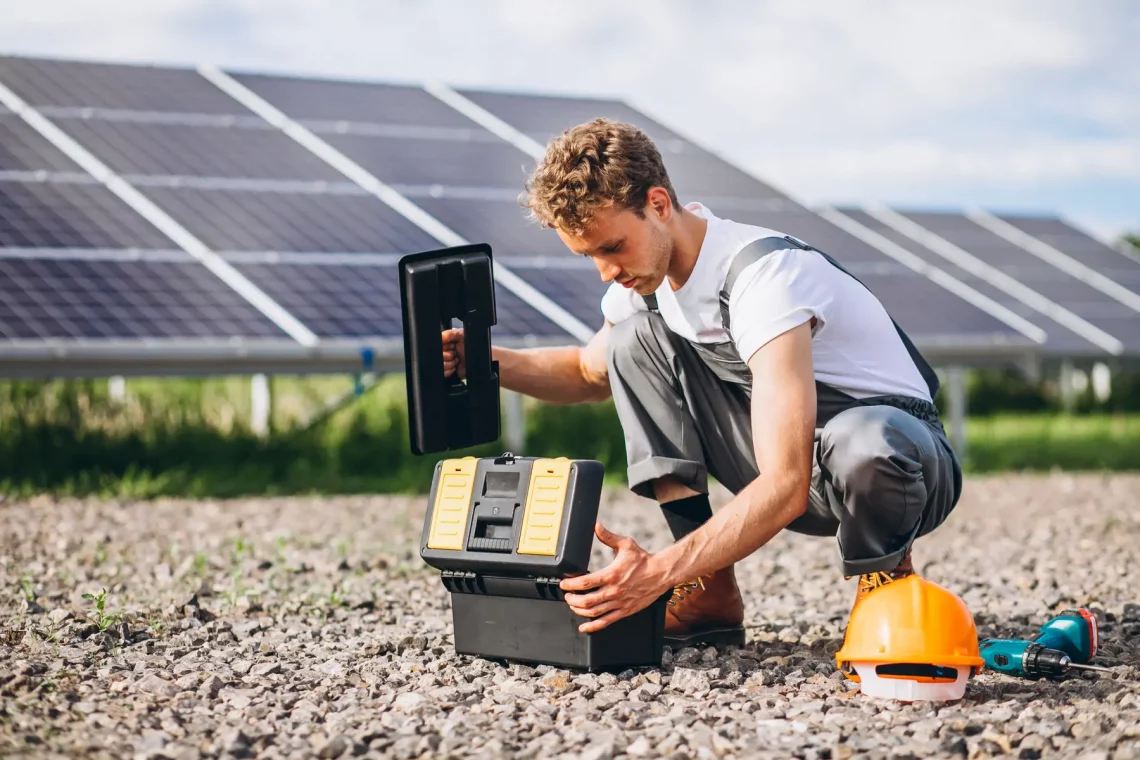
A solar PV installer in Germany can expect to earn around EUR 14.50–21 gross per hour, while in Poland, the reference salary for electrical installation workers is approximately PLN 5,600 gross per month. The difference becomes even more noticeable when daily allowances and accommodation provided by an employer or agency are added to the German base rate. However, moving to Germany does not automatically mean higher earnings in every job offer. Experience, region, language skills, type of employment and the rules for calculating additional payments all play an important role.
If you are interested in working in renewable energy, solar photovoltaics is one of the fields that allows you to enter the industry either as a helper or a qualified installer. In Poland, a UDT certificate is an important part of the professional career path, whereas German employers often place greater emphasis on practical experience.
Solar PV Installer Salaries in Numbers – Poland vs. Germany Comparison Table
| Criteria | Poland | Germany |
|---|---|---|
| Typical salary | Approx. PLN 5,600 gross/month | EUR 2,500–4,500 gross/month |
| Hourly rates | Depend on the contract and experience | EUR 14.50–21 gross/hour |
| Daily allowances | Usually depend on the contract and assignment | EUR 8–40/day or EUR 3.50–9/hour |
| Experience | Helpers can start without experience | Usually 1–2 years for an installer position |
| Language | No specific requirement | From no requirement to A2–B2 |
| Accommodation | Depends on the employer | Often provided by the employer or agency |
| Seasonality | Noticeable, especially from March to October | Usually lower for full-time employment |
The figures should be treated as estimated ranges rather than guaranteed salaries. In Germany, it is particularly important to check whether the amount stated in a job offer is gross or net and whether the daily allowance is paid in addition to the basic rate.
Hourly and Monthly Rates (Including Daily Allowances and Accommodation)
Hourly rates for solar PV installers in Germany are approximately EUR 14.50–21 gross per hour, while additional payments can increase total income by another EUR 8–40 per day. Some job offers also include daily allowances calculated on an hourly basis, ranging from EUR 3.50–9 per hour. As a result, two offers with the same basic hourly rate may provide completely different monthly earnings in practice.
For full-time employment, typical monthly salaries range from EUR 2,500 to 4,500 gross. Some offers also advertise net salaries of around EUR 2,900–3,400 per month. However, these amounts cannot be directly compared with gross salaries without taking taxes and social security contributions into account.
Accommodation is also an important factor. In the installation industry, employers or agencies often arrange and partially or fully finance accommodation. The same applies to daily allowances. You should check your contract to determine whether these payments are made in addition to your salary or whether their amount depends on the number of hours or days worked.
Experience and Language Skills – What Do Employers Expect?
Around 1–2 years of experience is the most common requirement in German job offers for independent solar PV installers. At the same time, there are vacancies for people without experience, although these more often concern assistant positions rather than independently carrying out an entire installation.
If you are just starting out, you can perform simpler tasks under the supervision of a more experienced installer. Your responsibilities may include preparing structures, transporting components, assisting with cable installation or preparing the installation site.
There is no single, universal level of German required throughout the industry. When working on large solar farms as part of a Polish-speaking or international team, you may find job offers stating that German is not required. The situation is different when installing systems for private customers. In such cases, an employer may expect language skills at A2–B2 level, as communicating with customers is part of the job.
Regional Differences – Where Are Solar PV Installers Paid the Most in Germany?
Bavaria and Baden-Württemberg are among the regions where solar PV installers may earn higher salaries than the average rates on the German market. This is influenced by demand for specialists, the large number of investments in photovoltaics and favourable sunlight conditions.
However, this does not mean that every offer in these federal states will automatically be the best paid. When comparing job advertisements, you should also consider the cost of living, accommodation expenses, the number of working hours, the work schedule and the amount of daily allowances.
An offer of EUR 19 gross per hour with paid accommodation may be more beneficial for you than EUR 21 gross per hour if you have to cover high accommodation costs yourself under the second offer. That is why, when planning to work abroad, it is worth considering the entire compensation package, rather than focusing on just one figure in the job advertisement.
Solar PV Installer in Poland – A Reference Point
Approximately PLN 5,600 gross per month is the average salary level reported for electrical installation workers and can be used as a reference point for the Polish market. Service technicians earn around PLN 400 gross more on average, while people with additional qualifications may negotiate higher rates.
The Polish market offers opportunities to start a career without extensive experience. As an installation assistant, you do not necessarily need specialised education, as some companies provide internal training. However, if you want to work independently, relevant qualifications and practical skills are important.
UDT Certificate – An Important Requirement for Entering the Profession
The UDT certificate is a key official document in the Polish market for people who want to carry out independent installation work involving photovoltaics. UDT, the Polish Office of Technical Inspection, is an institution that issues certificates confirming the qualifications of renewable energy installation technicians.
To begin the certification process, you must meet one of the specified entry requirements, such as having the appropriate education, work experience or completing a relevant course. A special pathway is available to graduates of the renewable energy technician programme (technik OZE). In their case, it is possible to obtain the certificate without taking an examination.
The cost of obtaining the document is approximately PLN 3,250–3,750, including training, the examination and certificate issuance. If your salary increases by around PLN 1,500–2,500 per month, the investment may pay for itself within approximately 2–3 months.
It is worth remembering, however, that a Polish UDT certificate should not automatically be considered mandatory or recognised by every German employer. In Germany, documented experience, the scope of work performed and the specific qualifications required for a particular position are often more important.
Salary Ranges and Seasonal Work
The main period of intensive installation work in Poland runs from March to October. During this time, earnings may increase by around 20–30% due to overtime and bonuses. In winter, the pace of work usually slows down, and earnings more often return to the basic level.
Seasonality is one of the most important characteristics of the Polish market if you plan to earn your living exclusively from solar PV installation. During months with a high number of projects, you may work more hours and benefit from additional shifts. The number of installations may decrease in winter.
This does not mean that there is no work at all. During the autumn and winter months, service, modernisation and energy storage projects are also available. The growing importance of hybrid systems means that it is worth developing skills not only in panel installation but also in working with additional system components.
Permanent Employment or B2B – Which Is More Profitable?
B2B becomes noticeably more financially attractive when monthly invoiced revenue exceeds approximately PLN 13,000–15,000. At lower revenue levels, an employment contract may prove more beneficial after taking taxes, contributions and business operating costs into account.
With a B2B arrangement, you may achieve higher net income and greater flexibility, but you also take on some of the risks associated with running a business. You need to consider contributions, accounting, taxes, periods without assignments and the lack of certain benefits typically available under an employment contract.
An employment contract (UoP) provides greater predictability and employee protection. If you are still gaining experience or your main priority is stability, permanent employment may be a sensible option, even when the nominal B2B rate looks more attractive.
Poland or Germany – Where Can a Solar PV Installer Earn More?
Germany offers significantly higher earning potential – approximately EUR 14.50–21 gross per hour and EUR 2,500–4,500 gross per month, often with additional daily allowances and accommodation. However, this does not mean that every move abroad will be more profitable than working in Poland.
In Poland, the basic salary is lower, but you can gradually increase the value of your work through a UDT certificate, experience and progression into more responsible positions. A disadvantage remains the noticeable seasonality, particularly during winter.
In Germany, the wide variety of job offers plays a greater role. One advertisement may be for an inexperienced assistant, while another may require at least 2 years of practical experience, independence and knowledge of German. Different methods of calculating daily allowances also need to be considered.
If you already have experience and can find an offer with a good rate, paid accommodation and a daily allowance, moving to Germany for work may significantly increase your monthly income. If you are just starting out, Poland may be a good place to gain practical experience and qualifications.
The prospects in both countries remain linked to the development of the renewable energy market. The installed photovoltaic capacity in Poland is approximately 24.5 GW, and according to IEO forecasts, it may increase to around 28.5 GW by 2030.
If you are considering working abroad, do not compare hourly rates alone. Check the number of working hours, required experience, language level, daily allowances, accommodation costs and contract type. It is also worth checking current job offers for solar PV installers in Germany on the europa.jobs search engine, as rates and recruitment conditions may change faster than average market figures.
Related articles:
- https://blog.europa.jobs/en/art-construction-worker-in-poland-germany-and-the-netherlands-salary-comparison-2026/
- https://blog.europa.jobs/en/art-cnc-operator-in-the-netherlands-and-germany-the-most-profitable-destinations/
FAQ
Is a Polish UDT certificate required to work as a solar PV installer in Germany?
There is no single rule requiring every installer in Germany to hold a Polish UDT certificate. In practice, German employers often focus primarily on documented experience, practical skills and the qualifications required by a specific job offer.
Do you need to speak German to work in solar PV installation in Germany?
German is not required for some job offers, but working with customers may require A2–B2 language skills. On large solar farms, work is often carried out in teams, so some employers accept candidates without knowledge of German.
How much does a solar PV installer without experience earn?
A person without experience may find an assistant position, but they will usually not receive rates from the upper end of the EUR 14.50–21 gross per hour range. As practical experience grows and the ability to perform installations independently develops, the number of available positions and potential earnings increase.
Are solar PV installer salaries seasonal?
Seasonality is noticeable in Poland, especially between March and October, when earnings may increase by approximately 20–30%. Installation activity decreases in winter, while full-time employment in Germany may offer more year-round work. However, this also depends on weather conditions, the type of project and the individual employer.
What do accommodation and daily allowances usually include when working in Germany?
German job offers often provide accommodation and daily allowances of EUR 8–40 per day or EUR 3.50–9 per hour. Accommodation is usually organised by the employer or agency and may be partially or fully financed. Therefore, always check the exact conditions in your contract before travelling.
Is employment or B2B more profitable for a solar PV installer?
B2B starts to offer a clear financial advantage when monthly invoiced revenue reaches approximately PLN 13,000–15,000 or more. At lower revenue levels, UoP may be more beneficial after considering all costs and obligations. In addition, an employment contract provides greater stability and employee protection.