
Renting an apartment in the Netherlands requires careful preparation, as competition on the rental market is fierce and prices continue to rise. How can you find a place to live in the Netherlands? Most listings are available on platforms such as Pararius, Funda and Kamernet, through real estate agents or via your employer. In 2026, the average rent in the private rental sector has reached €19.32 per m² per month. At the same time, Dutch regulations protect tenants against excessive security deposits and unjustified agency fees, among other things.
How to Find an Apartment in the Netherlands: Where to Look for Rental Listings
Most rental properties are advertised online. However, given the high level of competition, it is worth using several sources at the same time.
Rental websites
If you are looking for an independent apartment (huurwoning), start with these popular websites:
- Pararius – a wide range of private-sector rental properties, often listed by real estate agencies.
- Funda – primarily known for property sales, but it also features rental apartments.
- Kamernet – a good place to look for rooms (kamers) and smaller properties.
- HousingAnywhere – furnished apartments and rooms, particularly useful for medium-term rentals.
- Airbnb – temporary accommodation for the first few days or weeks after arriving in the Netherlands. This gives you time to look for a long-term rental and arrange viewings. However, keep in mind that short-term accommodation can be expensive, and a booking does not replace a standard rental agreement.
It is worth setting up alerts for new listings. Attractive properties can be rented out within just a few hours. However, be cautious when dealing with listings posted on social media.
Real estate agents (makelaar) – who pays the agency fee?
A real estate agent (makelaar) can help you find an apartment, arrange viewings and negotiate the terms of your rental agreement. However, if the agent is working on behalf of the landlord, they are not allowed to charge you an agency fee (bemiddelingskosten). This also applies to fees labelled as administrative or registration charges if they are, in fact, commissions for arranging the rental.
Social housing (sociale huur) offered by housing associations
A cheaper alternative is housing provided by housing associations (woningcorporatie). However, access is limited, and waiting times in major cities can be as long as several years. Income requirements also apply. If you are planning to stay in the Netherlands for a longer period, it is worth registering with a regional housing allocation system as early as possible.
Accommodation provided by an employer or employment agency
If you are just arriving in the Netherlands, accommodation arranged by your employer or employment agency may be a good option. Before signing any documents, check the property’s standard, the rental costs and the termination conditions.
Since 1 July 2023, the rental agreement must be separate from the employment contract. An employer can deduct rent from your salary only with your written consent and if certain conditions are met, including the accommodation having an SNF or AKF certificate. The deduction cannot exceed 25% of the minimum wage. It is also worth checking the current job offers in the Netherlands with accommodation, especially if you do not have your own place yet.
How Much Does It Cost to Rent an Apartment in the Netherlands in 2026?
Rental prices mainly depend on the location, floor area, standard of the property and type of rental agreement. According to a report by NVM and VGM NL, the average rent in the private rental sector was €19.32 per m² per month in the second quarter of 2026. Meanwhile, Pararius reported an average monthly rent of €1,914 in this segment in the third quarter.
Average rental prices in major cities according to NVM and VGM NL in Q2 2026:
| City | Average rent per m² |
|---|---|
| Amsterdam | €25.70 |
| Utrecht | €22.49 |
| The Hague | €20.82 |
| Rotterdam | €19.67 |
| Eindhoven | €16.64 |
For example, a 40 m² apartment in Rotterdam costs approximately €787 per month, excluding additional charges. This estimate is based on the average rental price per square metre and is not a guaranteed price for a specific property.
In addition to the basic rent (kale huur), you should also budget for:
- service charges (servicekosten), such as cleaning shared areas;
- electricity, gas and water bills;
- internet and TV;
- municipal taxes and charges (gemeentelijke belastingen), including waste collection fees;
- possible home or contents insurance.
Keep in mind that municipal charges vary depending on where you live. Before signing the rental agreement, ask the landlord for a detailed breakdown of all monthly costs.
Renting a Room or an Apartment in the Netherlands: Which Should You Choose?
Most people initially choose a room in a shared apartment because it is cheaper and easier to find than an independent property.
| Room in a shared apartment | Independent apartment |
|---|---|
| Lower rent and shared bills | Full privacy and peace and quiet |
| More properties available | Greater long-term stability |
| Easier to settle in thanks to flatmates | No disputes over noise or household chores |
| Shared kitchen and bathroom | Higher rent and stricter landlord requirements |
A room is a good option if you are just arriving in the Netherlands, want to save money and do not mind sharing your living space with other people. An independent apartment is a better choice if you have a stable income, plan to stay for longer or are moving with your family.
The maximum security deposit for a room is also limited to two months’ basic rent. Be cautious of listings stating “no address registration” (zonder registratie). This may indicate illegal accommodation or that the property exceeds the permitted number of occupants.
Social, Mid-Rent and Private Rental Sectors: How Does the Points System Work?
In the Netherlands, rent for many properties is regulated through the WWS points system (Woningwaarderingsstelsel). Each property is awarded points based on factors such as floor area, quality, facilities, energy efficiency and property value.
Depending on the number of points, a property falls into one of three rental categories:
- Sociale huur – social housing intended for people who meet specific eligibility criteria.
- Middenhuur – the mid-rent sector, subject to rent regulation since 1 July 2024.
- Vrije sector – the private rental sector, where different rent-setting rules apply.
These regulations were introduced under the Affordable Rent Act (Wet betaalbare huur). If you want to check whether your landlord is charging too much, use the rent points calculator (huurprijscheck) on the Huurcommissie website. You can calculate the maximum rent for an independent apartment or room. If you find irregularities, you can request an assessment from the Rent Tribunal (Huurcommissie).
What Documents Do You Need to Rent an Apartment in the Netherlands?
Landlords usually want to verify the identity and financial situation of prospective tenants. Prepare the following documents in advance:
- an ID card or passport;
- an employment contract or employer’s statement (werkgeversverklaring);
- recent payslips (loonstroken);
- a bank statement;
- references from a previous landlord, if available.
Some landlords require a gross income several times higher than the monthly rent. According to Pararius’ report for Q3 2026, the standard requirement in the private rental sector was approximately three times the rent. With an average rent of €1,914, this means you would need to demonstrate a gross monthly income of around €5,742.
If you work through an employment agency and have a temporary contract, finding an apartment may be more difficult, but it is not impossible. It is worth providing your employment history, several recent payslips and proof of savings.
Rental Agreements in the Netherlands: What Should You Pay Attention To?
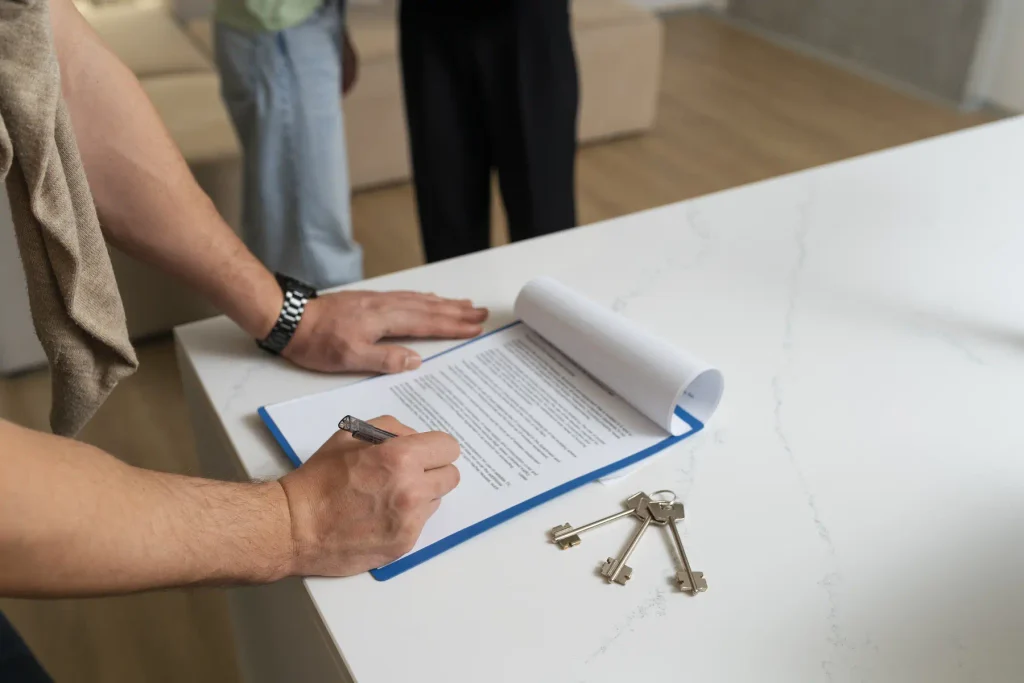
A rental agreement must be drawn up in writing. Since 2023–2024, regulations have provided tenants with additional protection, so make sure you carefully review the terms before signing.
Indefinite-term contracts are the standard
Since 1 July 2024, under the Fixed-Term Rental Contracts Act (Wet vaste huurcontracten), indefinite-term rental agreements (huurcontract voor onbepaalde tijd) have become the standard. Fixed-term contracts are only permitted in specific circumstances, for example, for certain students or people temporarily staying outside the Netherlands. Simply labelling an agreement as “temporary” does not mean that the landlord can arbitrarily limit your rights.
A security deposit of no more than two months’ rent and no agency fees
Since 1 July 2023, the security deposit (borg) for new rental agreements has been limited to a maximum of two months’ basic rent. The landlord must also inform you in writing about the rules for returning the deposit. They cannot charge you an agency fee if the agent is acting on their behalf.
Basic rent and service charges must be listed separately
The rental agreement should clearly distinguish between basic rent (kale huur) and service charges (servicekosten). The landlord is required to provide an annual statement of additional costs. You should also pay attention to the property handover report, photographs documenting the condition of the apartment, the notice period and whether you can register at the address.
Registering with the Municipality (BRP) and Getting a BSN Number: Why Are They So Important?
If you plan to live in the Netherlands for more than four months, you must register with the municipality within five days of arriving. Registration in the Personal Records Database (BRP) allows you to obtain a BSN number, which is a Dutch identification number required for dealing with government authorities, tax matters and accessing healthcare, among other things.
If you stay in the Netherlands for less than four months, you can register as a non-resident in the RNI system and also obtain a BSN number. If you are not allowed to register at your rental address, this should raise concerns. It may indicate that the accommodation does not comply with regulations or that the property exceeds the permitted occupancy limit.
How to Avoid Rental Scams in the Netherlands
Be particularly careful when searching for accommodation. The most common warning signs include:
- being asked to pay a security deposit before viewing the property;
- a landlord living abroad who wants to send the keys by post;
- a price significantly below the market average;
- no written rental agreement;
- a ban on registering at the address;
- a security deposit exceeding two months’ basic rent or an unjustified agency fee.
Do not transfer any money before verifying the property and the landlord’s identity. Ideally, view the apartment in person. If this is not possible, request a video call. Pay the security deposit by bank transfer and keep the payment confirmation.
If the landlord violates your rights, you can report the matter to the municipal reporting office (meldpunt goed verhuurderschap) or the Huurcommissie. If you suspect fraud, contact the police.
How to Rent an Apartment in the Netherlands Step by Step
If you want to go through the entire process smoothly, follow these steps:
- Set your budget and choose a city – include rent, bills, the security deposit and moving costs.
- Prepare your documents – gather your employment contract, proof of income and bank statements.
- Search on several platforms – use Pararius, Funda and Kamernet and set up alerts.
- View the property – check its condition in person or through a reliable video call.
- Verify the rent and rental agreement – check the points system, security deposit and additional charges.
- Sign the agreement and pay the deposit – use a bank transfer so you have proof of payment.
- Register with the municipality – make sure you are registered in the BRP and obtain your BSN number.
If you are planning to move, also check the latest job offers in the Netherlands on europa.jobs. Some employers and employment agencies provide accommodation, which can make settling into a new country much easier.
Related articles:
- https://blog.europa.jobs/en/art-how-to-save-money-effectively-in-germany-and-the-netherlands-while-working-in-warehousing-or-logistics/
- https://blog.europa.jobs/en/art-preparing-for-seasonal-work-in-the-netherlands-tips-and-checklists/
FAQ – Frequently Asked Questions
1. Can I rent an apartment in the Netherlands if I work through an employment agency?
Yes. However, a temporary contract may make it more difficult to get a landlord’s approval. An employer’s statement, recent payslips and proof of savings can help. You can also use accommodation provided by the agency when you first arrive.
2. How can I rent a room in the Netherlands, and do the same rules apply?
Rooms (kamers) are mainly available on Kamernet and other listing websites. Renting a room is also subject to regulations regarding written contracts, maximum security deposits and the ban on unjustified agency fees. Rooms are covered by the points system, which allows you to check the maximum rent.
3. Can I receive housing benefit in the Netherlands?
Yes, you can apply for housing benefit (huurtoeslag) if you meet the requirements regarding age, income, assets and place of residence. EU citizens can also qualify if they legally reside in the Netherlands and meet the other conditions. You can check your eligibility on the Dutch tax authority’s website (Belastingdienst / Dienst Toeslagen).
4. What should I do if my landlord refuses to return my security deposit?
The landlord should return your security deposit within 14 days of the end of the tenancy. If they deduct legitimate costs, they must provide an itemised statement and return the remaining amount within 30 days. If you do not receive your money, send a formal written payment request and seek assistance from Juridisch Loket or the relevant authorities.
5. How long does it take to find an apartment in the Netherlands?
The time it takes depends on the city, your budget and the type of property. In Amsterdam, Utrecht or The Hague, finding an independent apartment may take several weeks or months. A room or employer-provided accommodation can usually be found more quickly.