
A shift in a German warehouse may start at 6:00 a.m. and finish at 2:00 p.m. During this time, employees handle tasks such as receiving goods, picking orders, packing, labeling and preparing shipments. Warehouse work is usually organized in shifts and requires good organization, physical fitness and compliance with safety rules. However, some positions are also available to people without previous experience.
A Day in the Life of a Warehouse Worker in Germany – Step by Step
A warehouse worker’s daily duties depend on the type of warehouse, the position and the department they are assigned to. The day looks different for someone responsible for receiving deliveries than for an employee picking orders. However, the daily work of a warehouse operative generally follows a fairly repetitive routine.
Start of the Shift – Briefing and Preparing the Workstation
The shift begins with entering the facility, changing into workwear and preparing for work. You may then receive information about current tasks, the number of orders or priority deliveries. In larger logistics centers, a short briefing may also include a reminder of workplace safety rules.
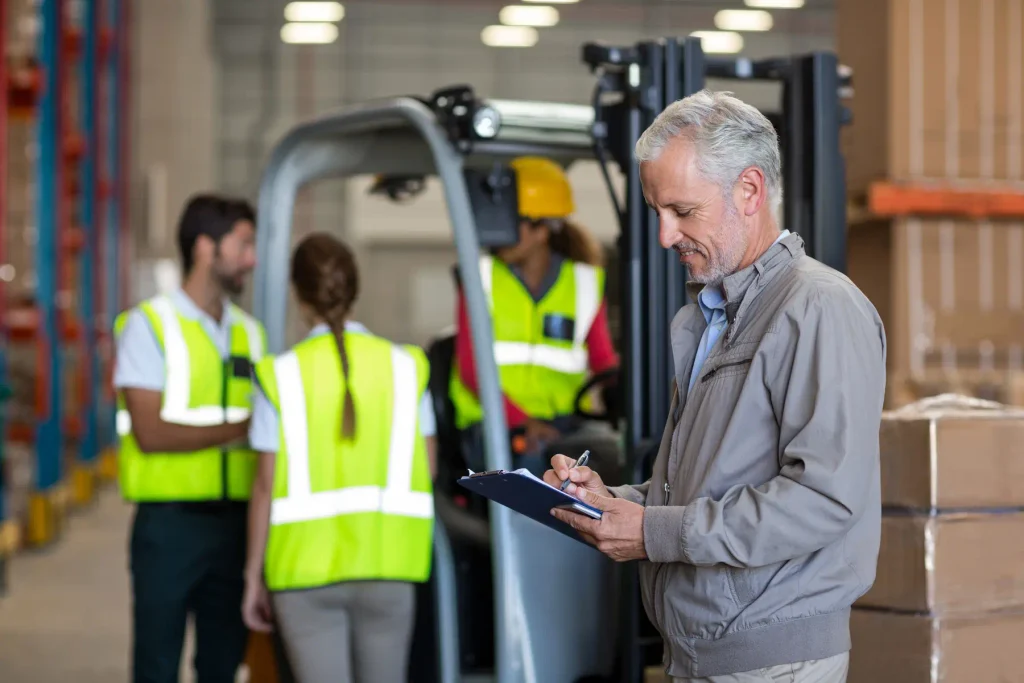
If you work in order picking, you may receive a scanner or another device used to process orders. Forklift operators, on the other hand, check their equipment before starting work. Employees are also required to use protective equipment, such as safety footwear or a high-visibility vest, and in some workplaces, gloves as well.
Main Duties – Receiving Goods, Picking, Packing and Shipping
One of the first stages of the process may be Wareneingang, meaning the receipt of goods into the warehouse. This task includes unloading deliveries, checking them against the documentation and verifying the quantity and condition of the products.
The next stage is Kommissionierung, or order picking according to a specific order. The employee moves between the warehouse racks and collects the required products, often using a scanner in a Pick-by-Scanner system or voice instructions through Pick-by-Voice. Depending on the warehouse, they may also be responsible for putting products away or relocating them to the appropriate racks, including in high-bay storage systems.
Once an order has been picked, the goods are sent for packing. Products need to be properly protected, packed and labeled. The prepared shipments then move to the Warenausgang, or shipping area. There, employees may check documentation, sort packages and prepare goods for loading.
Depending on the position, duties may also include operating a forklift. This is reserved for employees with the appropriate qualifications. Throughout the shift, it is also important to keep the workstation tidy and follow workplace safety procedures.
Breaks at Work – How Many and When According to German Law
For work lasting more than 6 hours, employees are entitled to at least a 30-minute break. If working time exceeds 9 hours, the minimum break is 45 minutes. The break may be divided into periods of at least 15 minutes. An employee cannot work for more than 6 hours continuously without a break.
In practice, this means that an 8-hour shift usually includes at least a 30-minute break. The break is not included in working time. Therefore, if you work for 8 hours and have a 30-minute break, you may spend a total of 8.5 hours at the workplace.
It is important to distinguish between Ruhepause, meaning a break during a shift, and Ruhezeit. The latter refers to the uninterrupted rest period between the end of one working period and the beginning of the next. As a general rule, it lasts at least 11 hours.
End of the Shift and Recording Working Hours
At the end of the shift, the employee finishes the current order or hands over tasks to another worker. In some warehouses, it is also necessary to return scanners, keys or equipment and tidy the workstation.
Accurate recording of working time is also important. The start and end times of the shift, breaks, overtime and any additional allowances should match the working-time records. This makes it easier to check whether the salary corresponds to the actual hours worked.
Shift Systems in German Warehouses
Shift systems are common in German logistics because distribution centers and warehouses often need to operate for most of the day. A standard working week usually consists of 38–40 hours, most often from Monday to Friday, although logistics jobs may also include weekend schedules.
Two-Shift and Three-Shift Work – What Do the Schedules Look Like?
The two-shift system is one of the most common arrangements. An example schedule may look like this:
- first shift: 6:00 a.m.–2:00 p.m.,
- second shift: 2:00 p.m.–10:00 p.m.
In a three-shift system, there is usually an additional night shift, for example from 10:00 p.m. to 6:00 a.m. Exact working hours depend on how the individual facility is organized.
Shifts may rotate, so you could work mornings one week and afternoons or nights the next. When planning the schedule, the required rest period between shifts must be taken into account. As a general rule, employees should have at least 11 hours of uninterrupted Ruhezeit.
Allowances for Night Work, Sundays and Public Holidays
Allowances can significantly increase the final pay. Their amount depends on the employer, collective agreement and employment contract. Therefore, the figures below should be treated as typical market levels rather than statutory rates.
The following rates are often seen:
- +25% for night work,
- +50% for Sunday work,
- +100% for work on public holidays,
- +25% for overtime,
- +5–15% shift allowance (Schichtzulage).
In practice, this means that two people performing similar duties for 8 hours may receive different pay depending on the working hours, day of the week and applicable allowances.
How Much Does a Warehouse Worker Earn in Germany? Including Allowances
In 2026, the statutory minimum wage in Germany is EUR 13.90 gross per hour. The typical hourly rate for a warehouse worker on a day shift is around EUR 14–17 gross per hour. With night work and a 25% allowance, the rate may reach approximately EUR 17.50–21 gross per hour.
For a full-time position of around 40 hours per week, a warehouse worker’s monthly salary usually falls between EUR 2,200 and EUR 2,900 gross. Agency job offers may also advertise amounts of around EUR 1,700–2,600 net. However, the final salary depends on factors such as tax class, number of hours worked, allowances and deductions.
Employees with a Staplerschein, the German qualification for operating forklifts, may be able to earn higher rates. In selected specialist positions, pay can reach EUR 22–25 gross per hour, while the median monthly salary for warehouse workers with these qualifications is around EUR 2,438. Fully qualified and highly experienced workers in specialized positions may also earn up to EUR 5,000 per month.
Some warehouses also offer additional allowances for working in refrigerated or frozen environments. These may increase as the temperature decreases. Some employers also offer Weihnachtsgeld, a Christmas bonus, but this is not a statutory benefit.
What Does an Employer Require? Qualifications and Licenses
Many basic warehouse positions do not require previous experience because on-the-job training is provided after employment begins. Accuracy, physical fitness, willingness to work shifts and compliance with procedures are often more important.
Working Without Experience – What Do You Really Need to Know to Start?
Many job offers only require a willingness to perform physical work and the ability to follow instructions. New employees can be trained to use scanners, follow picking procedures and comply with the rules applicable at a particular warehouse.
Staplerschein – Forklift Qualification and How It Can Increase Your Earnings
A Staplerschein can significantly increase your chances of finding a better-paid position. It may be worth obtaining the qualification before moving to Germany or checking whether the employer or agency offers the possibility of obtaining it locally.
Do You Need to Speak German?
Not always. There are job offers advertised as work in Germany without German language skills, particularly for basic warehouse positions. However, even basic German is a major advantage. It makes it easier to understand instructions, communicate with supervisors and participate in workplace safety training.
Physical Working Conditions – What Should You Expect?
Physical work in Germany in a warehouse mainly involves spending many hours on your feet, walking, bending and occasionally lifting and moving goods. It is not a desk job, and its repetitive nature may not suit everyone.
Working conditions depend on the industry. In food or pharmaceutical warehouses, employees may work in reduced temperatures, refrigerated areas or freezers. Additional allowances are often available for such conditions. Protective clothing is also standard, especially safety footwear and high-visibility vests. Gloves may also be required in some workplaces.
Polish workers are often employed through temporary employment agencies. An agency may provide accommodation, usually costing around EUR 150–300 per month, which may be deducted from the salary. Agencies may also arrange transportation to work and provide support from a Polish-speaking coordinator.
If this type of work suits you, it is worth checking current warehouse jobs in Germany and comparing not only the hourly rate but also the shift system, allowances, accommodation costs and experience requirements.
Related articles:
- https://blog.europa.jobs/en/art-work-in-logistics-in-europe-how-much-do-packers-warehouse-workers-and-forklift-operators-earn/
- https://blog.europa.jobs/en/art-how-to-find-your-first-job-abroad-a-practical-guide-for-people-without-experience/
FAQ
1. Do You Need to Speak German to Work in a Warehouse in Germany?
Not always. Many basic positions are available without German language skills. However, even basic German makes it easier to follow instructions, participate in training and communicate in workplace safety situations.
2. How Long Is the Break During an 8-Hour Warehouse Shift?
For work lasting more than 6 hours, the statutory minimum is 30 minutes. The break is not included in working time and may be divided into two 15-minute periods.
3. How Much More Can You Earn by Working the Night Shift?
A typical market allowance is around 25%. Therefore, with a basic rate of EUR 14–17 gross per hour, the night rate may reach approximately EUR 17.50–21 gross per hour. Exact conditions depend on the employer or collective agreement.
4. Is It Worth Getting a Forklift Qualification (Staplerschein) Before Moving to Germany?
If you plan to work in logistics for a longer period, this qualification can increase the number of available job offers. It may also allow you to earn around EUR 22–25 gross per hour in selected positions.
5. How Many Consecutive Days Can You Work in a Shift System in Germany?
Under standard working-time arrangements, a maximum of 6 consecutive working days is generally permitted. A day off should then follow. Detailed rules may depend on the work system, industry and exceptions provided for by law. German regulations also govern rest periods between shifts and generally require at least 11 hours of uninterrupted Ruhezeit.
6. What Is Accommodation Like When Warehouse Work Is Organized by an Agency?
Agencies often provide accommodation in shared apartments or worker housing. The cost is usually around EUR 150–300 per month and may be deducted from the salary. Before signing a contract, it is worth checking the standard of the accommodation, the number of people per room, the distance from the warehouse and transportation costs.