
A sudden accident while carrying out your professional duties abroad is an extremely stressful situation in which it is easy to make mistakes with serious consequences. The language barrier, lack of knowledge of local employment law and pressure from supervisors can mean that many workers fail to take the necessary formal steps. As a result, they may lose access to benefits they are entitled to, such as medical treatment, rehabilitation or compensation following a workplace accident.
Regardless of whether you work in Germany, the Netherlands, Norway or the United Kingdom, there are several basic steps you should take after a workplace accident. We have prepared this practical guide in the form of a checklist to help you act correctly, step by step. It will help you protect your health, employment rights and potential financial claims from the very first minutes after the accident.
Step 1: Safety and first aid – what should you do immediately after the accident?
The first few minutes after an accident are crucial for your health and, in some cases, even for your life. Your absolute priority should therefore be to ensure your safety and obtain medical assistance rather than worrying about continuing your work or keeping the workflow going.
- Stop working immediately and secure the area: if your health allows it, switch off the machine, move away from the hazardous area and warn your colleagues to prevent anyone else from getting injured.
- Call for medical assistance or a first aider: in European Union countries, you can call the emergency number 112. You should also immediately notify the designated first aider at your workplace.
- Do not underestimate seemingly minor injuries: a bruise, sprain or back pain after lifting a heavy object can become more serious over the following days. In addition, if you do not undergo a medical examination promptly, it may later be more difficult to prove the connection between the injury and the workplace accident.
Clearly tell the doctor that the injury occurred during working hours or in connection with your professional duties. In many European countries, workplace accidents are subject to specific medical procedures. For example, in Germany, an employee who has suffered a workplace accident will generally need to see a Durchgangsarzt (D-Arzt), a doctor specialising in workplace and commuting accidents.
Step 2: Who must you officially notify? (Employer, temporary employment agency, occupational health and safety service)
Reporting the accident promptly to the appropriate people is an essential step. A delayed notification or failure to officially report the incident can make it more difficult to have the accident recognised and to obtain the benefits to which you may be entitled.
Who should you notify?
- Your direct supervisor (team leader, foreman or shift manager): report the accident immediately. If possible, also confirm the report by SMS or email so that you have written evidence.
- Temporary employment agency or recruitment agency: if you work through an agency, inform your coordinator or contact person as well. Depending on your employment arrangement, both the agency and the company where you are actually working may be involved in reporting and handling the accident.
- The person responsible for occupational health and safety: inform the person responsible for workplace safety and risk prevention and make sure that an official accident report is prepared.
- The labour inspectorate or relevant authority: in the event of a serious workplace accident, the employer may be legally required to report it to the competent authorities. In the United Kingdom, for example, certain accidents must be reported to the Health and Safety Executive (HSE) under the RIDDOR procedure.
Never sign an accident report written in a language you do not fully understand. If necessary, request a translation that you can understand or ask for sufficient time to review the document before signing it. Always keep a copy of every document you sign.
Step 3: Gathering evidence and medical documentation – how can you avoid problems later?
In the event of a dispute about the circumstances of the accident or its consequences, evidence can play a crucial role. The more carefully you document what happened and your medical condition, the easier it will be to assert your rights later.
- Take photographs and videos: document the accident scene, damaged tools or equipment, missing machine guards, liquid spilled on the floor, missing warning signs or defective personal protective equipment.
- Collect witnesses’ details: write down the names, telephone numbers and, if possible, email addresses of colleagues who witnessed the accident or helped you immediately afterwards.
- Keep all medical documentation: retain hospital discharge summaries, medical reports, referrals for rehabilitation, X-ray and MRI results, prescriptions and other treatment-related documents.
- Keep invoices and receipts: collect evidence of all expenses incurred, for example for medication, orthopaedic equipment, necessary travel to medical appointments or private specialist consultations.
- Keep a recovery diary: record the dates of medical appointments, the intensity of your pain and any limitations in your everyday life caused by your injuries.
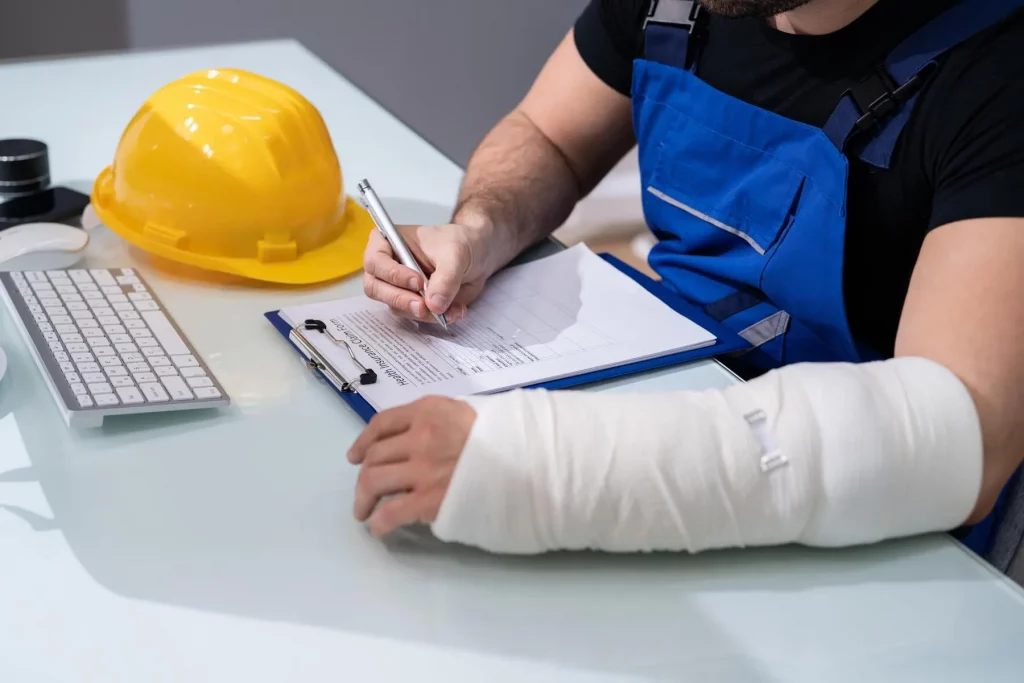
Step 4: Compensation and accident-related benefits – how can you claim your rights?
The benefits you may be entitled to following a workplace accident depend on the country, your employment status, the circumstances of the accident and its consequences. Many European countries have occupational accident insurance systems that can cover, among other things, medical treatment, rehabilitation and the long-term consequences of an accident.
What benefits may be available after a workplace accident?
- Continued salary payments, sickness benefits or accident-related benefits: depending on the country and applicable insurance system, certain benefits may fully or partially compensate for lost income during a period of temporary incapacity for work.
- Coverage of medical and rehabilitation costs: this may include medical treatment, surgery, physiotherapy and necessary medical equipment or aids.
- Compensation for permanent health consequences: if an accident results in long-term or permanent health problems, the legislation of the relevant country may provide for specific benefits.
- Accident pension or benefits for permanent incapacity for work: if the consequences of an accident permanently reduce your ability to work or earn an income, you may, under certain conditions, be entitled to a pension or another appropriate benefit.
The possibility of additionally claiming compensation for material and non-material damage also depends on national legislation and the specific circumstances of the accident. If the employer was negligent, for example by failing to comply with health and safety regulations or providing defective equipment, civil liability may arise in certain circumstances. However, the conditions for obtaining such compensation vary considerably from one country to another.
Conclusion: Workplace accident checklist
Taking quick and organised action after a workplace accident can help protect your health as well as your legal and financial interests. The most important thing is not to downplay the accident and to keep evidence of all the steps you have taken.
Save this checklist on your phone:
- Make sure you are safe and seek medical assistance – in an emergency, call 112. Tell the doctor that the injury occurred at work.
- Report the accident immediately to your employer or supervisor and, if you work through a temporary employment agency, inform your contact person there as well.
- Preserve evidence: take photographs of the accident scene and record the contact details of all witnesses.
- Request a copy of the accident notification or official accident report and keep all medical documentation carefully.
- Check which accident benefits, sickness benefits, medical cost coverage and, where applicable, compensation you may be entitled to from the relevant authority or insurer.
- Seek legal advice if the accident is not recognised, a benefit is refused or you disagree with the amount of compensation offered.
Knowing your rights and completing the necessary formalities promptly after a workplace accident increases your chances of receiving the medical care and benefits to which you may be entitled.
Related articles:
- How to get health insurance while working abroad? A practical guide
- Jobs That Have Disappeared Over the Last 20 Years: How Has the Labour Market Changed?
FAQ
1. What should I do if I have a workplace accident abroad?
First, make sure you are safe and seek medical assistance. Then report the accident to your employer or supervisor as soon as possible. If you work through a temporary employment agency, inform your contact person there as well. Remember to preserve evidence such as photographs of the accident scene, witness details and all medical documentation.
2. Who should I notify about a workplace accident abroad?
You should first notify your direct supervisor or employer. If you are employed through a temporary employment agency, you should also notify the agency. In the case of a serious accident, the employer may be required to report the incident to the relevant authorities in the country concerned.
3. Am I entitled to compensation after a workplace accident abroad?
You may be. The benefits you are entitled to depend, among other things, on the country, your employment status, the nature of the accident and its consequences. They may include coverage of medical and rehabilitation costs, benefits for incapacity for work, compensation for permanent health consequences or an accident pension.
4. How can I prove that an accident occurred at work abroad?
It is essential to report the accident promptly and keep all relevant documentation. Photographs of the accident scene, witness statements, medical records, the official accident report, as well as SMS messages, emails or other communications confirming that you reported the accident to your employer can serve as important evidence.